For years, the expensive part of making something was making it. A decent website needed a designer and developer. A campaign needed strategy, copy, artwork and a small parade of meetings. An internal tool needed a budget large enough to make everyone suddenly interested in governance.
That constraint is collapsing. AI tools can now draft the words, generate the visual directions, build working interfaces and help connect systems. The first version of almost anything is becoming faster and cheaper to produce.
This is excellent news. It is also why the internet is about to fill with an heroic quantity of perfectly acceptable rubbish.
This week’s signal: capability is not the bottleneck
The interesting story in AI is no longer simply that the models can write, draw or code. The stronger signal is that major platforms are turning those abilities into ordinary working tools.
OpenAI’s recent DevDay recap described agents taking on ongoing responsibilities rather than waiting for one prompt at a time. Its September note, The Work Now Within Reach, made a related argument: as capability rises and the cost of useful intelligence falls, jobs that were previously too fiddly, expensive or specialised become worth doing.
Canva is moving in the same direction from the creative side. Its AI suite brings design, image, text and interactive code generation into one workflow. That matters because it moves production capability closer to the business owner who has the idea—not only the specialist who knows which menu contains the correct obscure setting.
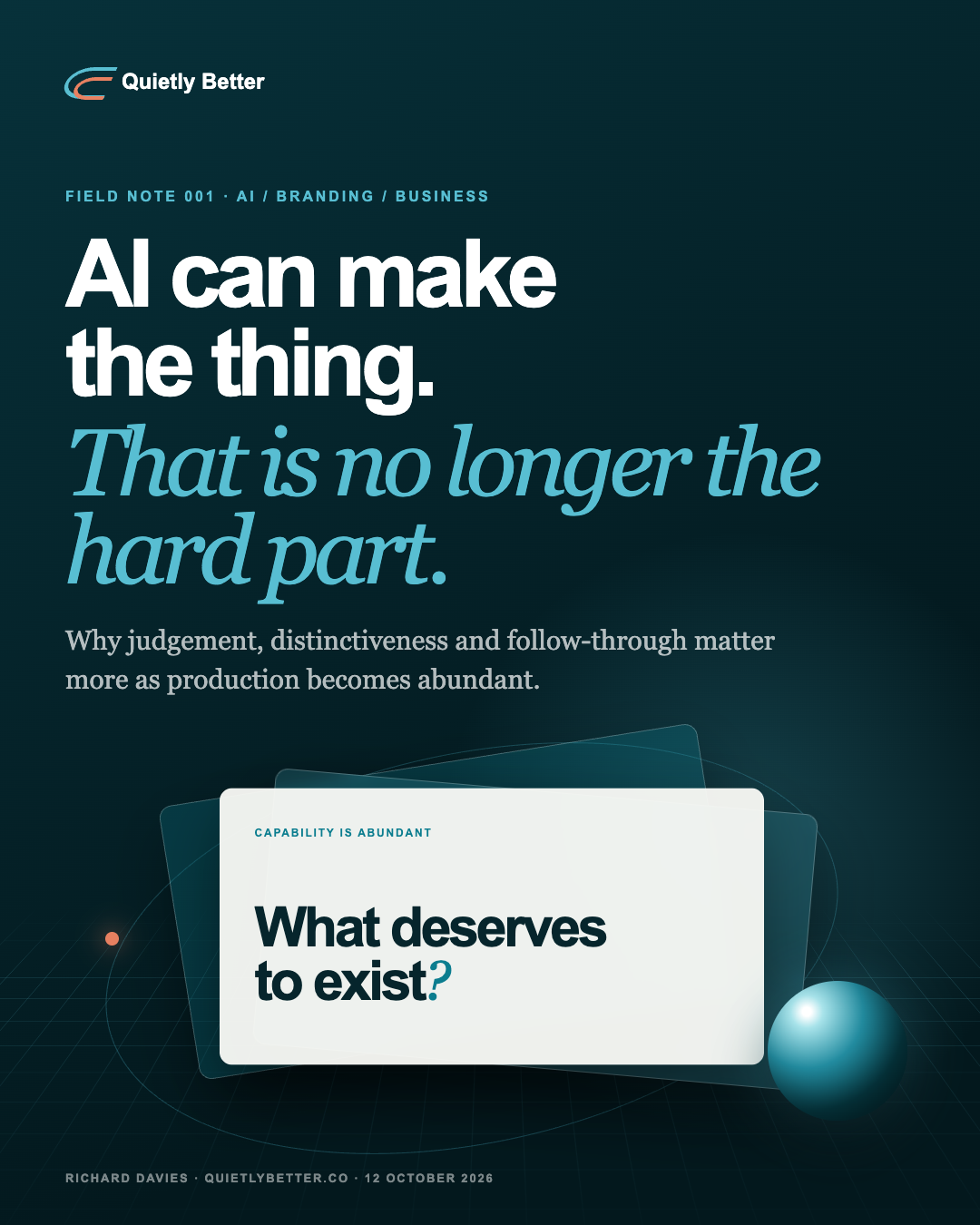
The tools are different, but the direction is consistent: producing a credible first version is becoming abundant. The scarce part is deciding what deserves to exist, what it should say, how it should feel and whether it actually helps the business.
Production is becoming abundant. Judgement is not.
Branding matters more when everyone can make more
When production was difficult, competence alone could make a business look impressive. Having a clean website, a tidy logo and a regular stream of social posts created separation because plenty of competitors had none of those things.
That baseline is moving. AI can give almost any business neat copy, plausible pictures and a polished layout. Unfortunately, it can also give ten competing businesses the same confident headline, the same suspiciously spotless team and the same blue gradient that appears to have escaped from a software conference.
A brand is not the decorative layer applied after the proper work. It is the pattern people recognise across the choices: what the business notices, what it refuses to say, how it explains the value, the quality of the details and the feeling left after an interaction.
AI can help explore those choices. It cannot decide them without a point of view. Give it a generic brief and it will usually produce a highly competent average. That is useful for getting unstuck and fairly disastrous as a long-term identity.
- Use AI to widen the field of ideas, then edit hard enough to reveal an actual point of view.
- Build a small set of recognisable visual and verbal rules instead of generating every item from scratch.
- Keep real places, real people, real products and real language in the material. Specificity is increasingly valuable.
- Ask whether a competitor could publish the same thing after changing the logo. If yes, it is content—not identity.
Websites are becoming behaviour, not brochures
The same shift is happening in web design. It is now much easier to build a polished page. That is not a reason to stop caring about design; it is a reason to expect more from it.
A useful website should respond, explain, guide and occasionally do some work. It might help a customer choose the right service, prepare an enquiry, understand a process, explore a product or get a sensible answer without waiting for someone to find the email from last Tuesday.
The three-dimensional physics element on the new Quietly Better site is a small example. It is there to demonstrate that the studio can design and build, not merely arrange rectangles until everyone is too tired to object. The movement has a purpose: it makes the capability tangible while the rest of the site remains calm and readable.
The rule is simple: interaction should strengthen the idea or improve the journey. If it merely makes the laptop fan sound worried, it can go.
The business lesson: workflow beats the impressive demo
OpenAI’s Partner Network announcement put the implementation problem plainly. Its view is that model capability is no longer the main limit; the harder work is choosing the right uses, redesigning workflows, integrating systems and helping people adopt the result.
That rings true for small business as well. A clever assistant shown once in a meeting is not a business system. The value appears when it has the right information, fits the actual handover, respects permissions, survives an ordinary Wednesday and gives a person a clear place to step in when judgement is required.
The best first AI project is rarely the most spectacular one. It is usually a repeated task with a clear owner, a visible cost and a result that can be checked. Drafting a consistent first response to enquiries may be more useful than an all-knowing digital executive with seventeen animated dashboards and no idea where the current price list lives.
- Start with one repeated point of friction, not a list of fashionable tools.
- Define the human decision before automating the preparation around it.
- Use the business’s real source material and decide who keeps it current.
- Test the awkward cases, not just the happy demonstration.
- Measure whether the work became faster, clearer or more reliable before expanding it.
A useful ninety-minute audit
You do not need an AI strategy retreat to respond to this shift. Start with a quiet ninety minutes and three sheets of paper—or one document with three headings if civilisation has moved on.
- Brand: list the five things customers should consistently feel or understand about the business. Compare them with the website and last ten social posts.
- Website: identify the three questions visitors need answered before they can take the next step. Check whether those answers are obvious on a phone.
- Business: write down the recurring task that keeps returning to the owner’s desk. Map what arrives, what judgement is needed and what a good result looks like.
- AI: choose one preparatory step that could be assisted without handing over the final decision. Test it with real examples and a clear stopping point.
Use AI to increase care, not volume
The tempting response to faster production is to produce much more. More articles, more posts, more emails, more variations, more things arriving in other people’s lives asking for attention.
The better response is to use the saved effort to improve the work: research the question properly, make the explanation clearer, build the useful interaction, check the mobile version, follow up the enquiry and notice when the customer is confused.
AI can make the thing. The advantage belongs to businesses that know which thing matters—and care enough to finish it properly.
Sources and further reading
The product and industry observations above are based on the organisations’ own announcements. They are useful primary sources, though naturally not disinterested commentary.
- OpenAI — DevDay 2026 recapRecent product direction, including agents taking on ongoing responsibilities.
- OpenAI — The Work Now Within ReachOpenAI’s argument that greater capability makes previously uneconomic work practical.
- OpenAI — Introducing the OpenAI Partner NetworkThe implementation gap: use-case choice, workflow redesign, integration and adoption.
- Canva — Design, code, and create with our biggest AI launches yetDesign, image, text and interactive-code generation moving into one creative workflow.
Know someone
who would use this?
Share the article directly, copy its permanent link or download the finished artwork for a manual social post.
https://quietlybetter.co/insights/ai-can-make-the-thing