You launch a website. It looks right on a phone, the contact button works and the business finally has somewhere decent to send people. Then you search for it, or for the service it offers, and find a great deal of everyone else. It is a rather expensive way to discover that opening the shop and being on the map are different jobs.
The noise around AI search makes this harder to untangle. There are new reports, new terms and plenty of people offering to make a business visible to machines. Before buying a new acronym, establish which part of the journey is actually missing: can the page be reached, has it been indexed, and does it give someone a reason to choose you?
This Field Note separates those questions and sets out a small, manageable search experiment. It is not a promise of rankings. It is a way to stop guessing, improve the information you control and recognise progress without mistaking it for a customer.
The update: AI discovery is becoming more inspectable
Google published a dedicated resource for optimising for generative AI search in May 2026. Its current guidance keeps conventional search fundamentals relevant; there is no separate magic file or special AI markup required for inclusion. That is a useful counterweight to claims that every small business needs an entirely new content operation.
Microsoft expanded Bing Webmaster Tools’ AI visibility preview in June with intent, topic, citation-share and period-comparison reporting. Those developments are dated context, not breaking news this morning. They show that publishers are getting more ways to examine how content is represented, although coverage and availability should be checked in the actual account.
My reading is that this makes careful diagnosis more valuable, not less. A report about citations answers a different question from a report about website visits. Neither tells you, by itself, whether a customer found the right service or made an enquiry.
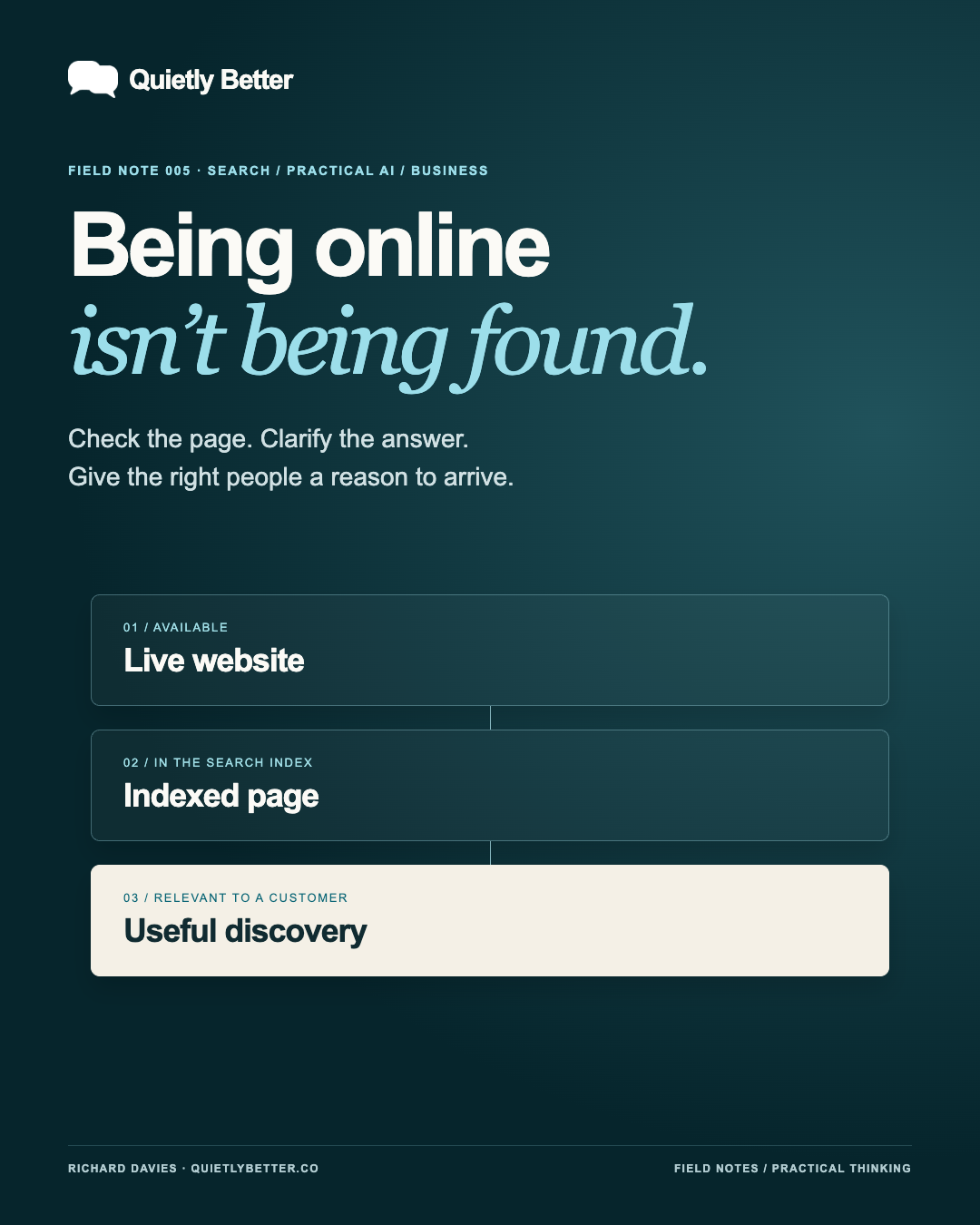
Separate live, indexed and discovered by a customer
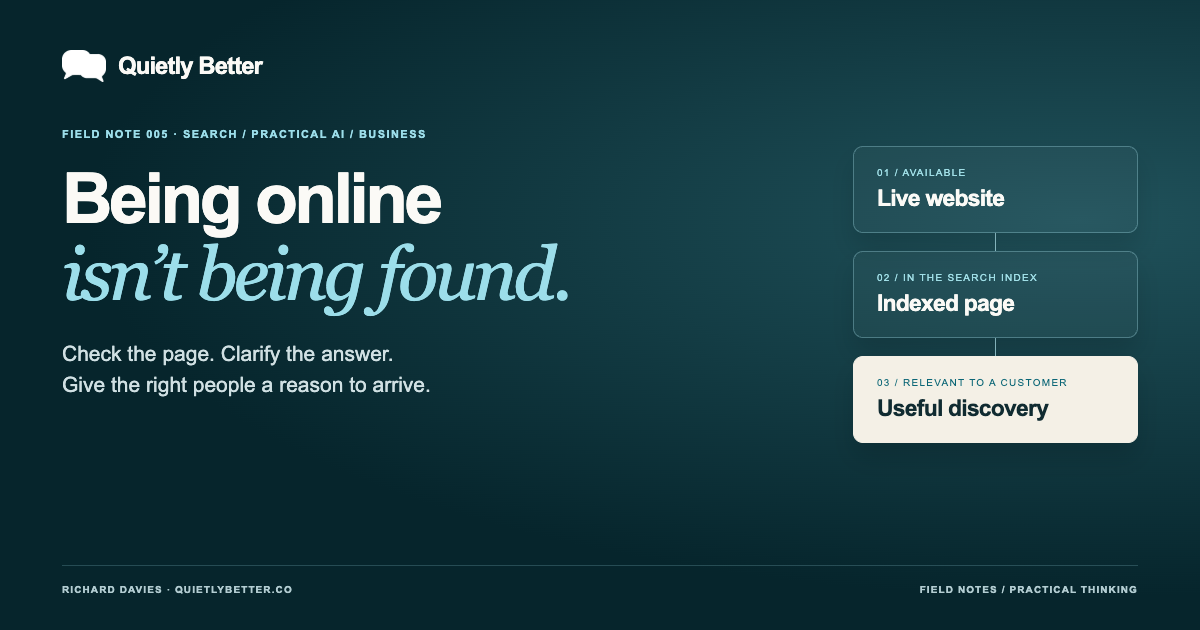
A live page is one your browser can open. An indexed page is one a search engine has included in its index. A useful discovery happens when the right person encounters it for a relevant reason. Keep those three states separate. A beautiful public page can still be absent from search; an indexed page can still attract the wrong audience.
A sitemap helps search engines discover addresses. A successful sitemap report is not a certificate that every listed page has been indexed. Likewise, a search appearance is not a visit, and a visit is not an enquiry. Put the exact observation beside the exact page and reporting date instead of colouring the whole project green.
Imagine a local repair business with a polished homepage and a useful page about repairing older equipment. If only the homepage is indexed, publishing another ten articles may not address the immediate problem. First establish what happened to that specific service page. This is an illustrative example, not a report about a client.
A successful launch is the start of discovery work, not proof that discovery has happened.
Inspect one important URL before rewriting the lot
In Google Search Console, choose the correct property and inspect the full address of one important public page. Read the stored indexing result, its stated reason and last crawl. Where available, compare the canonical address you supplied with the one Google selected. Save the observation date: an old report is still an old report, even when opened today.
Google distinguishes the stored index result from a live URL test. A live test can help investigate present accessibility and eligibility; it does not confirm that a page is already indexed. If the stored result says the URL is unknown, do not turn that into a diagnosis that the writing is bad. It tells you the reported indexing state, not the entire cause.
For a few important pages, an authorised owner or full user can request indexing. Google says crawling can take days to weeks and is not guaranteed. Repeated requests for the same address do not make it happen faster. Check the reported blocker first, make any justified correction, then record the action and a sensible later review date.
Make one page genuinely worth finding
Once the technical question is understood, look at the page as a customer would. Does it describe a recognisable need, or merely announce that the business offers solutions? An owner searching for help with a slow, confusing website needs more than a paragraph about innovation and excellence. So does the person standing in a car park trying to establish whether you repair their particular machine.
Build a useful answer around the actual service. Explain who it suits, what is included, what is not, how the work starts and what information you need to quote. Where a fixed price would be misleading, explain the variables rather than inventing a reassuring number. Include real examples with permission, and label demonstrations or concepts honestly.
A hypothetical accommodation page might explain accessible arrival information, the booking handover and what happens when plans change. A trades page might explain service boundaries and the photographs needed for an initial assessment. Neither needs to become an encyclopaedia. The test is whether the reader leaves knowing something useful enough to make the next decision.
- Choose one customer question you repeatedly have to explain.
- Answer it with specifics you can verify, not borrowed confidence.
- Add an original example, diagram or photograph that clarifies the answer.
- Finish with one appropriate next step and a clear owner of the enquiry.
Connect the useful page to the rest of the business
A page can be technically public and practically hidden. Give it a sensible route from your services, relevant articles or project examples. Google recommends ordinary crawlable links with descriptive wording and says every important page should have a link from another page on the site. A navigation label should help a human understand the destination too.
Then make social content a genuine introduction to that answer. Show one detail: a confusing enquiry form made clearer, a brand colour used consistently, or the information a customer should gather before asking for a quote. Link the Facebook post to the matching page when the format supports it. For an Instagram feed caption, give a realistic route through the profile rather than pretending a pasted URL behaves like a website button.
Relevant mentions from a real collaborator or community organisation can help people find useful work. A manufactured network of compliments is another matter. Ask whether the link makes sense for the other site’s audience without a search engine in the room. If it does not, it is probably not the relationship worth building.
Use AI to clarify, not multiply
There is useful work for AI here. Give it an approved service outline and ask which customer questions remain unanswered. Have it identify inconsistent terminology, propose clearer headings or turn your own explanation into an initial draft. Check every factual statement and keep customer information out of unapproved tools. The responsibility stays with the business publishing the page.
The unhelpful version is generating fifty near-identical pages with different town names. It creates a maintenance burden before it creates a reason to visit. My recommendation is to put the same effort into one substantial answer, one original demonstration and a person who will respond properly when somebody asks about it.
Google’s AI-feature documentation says a supporting page must be indexed and eligible for a search snippet. It also says meeting requirements does not guarantee inclusion. Do not let an AI visibility score persuade you to skip the ordinary indexing check. And do not treat Google guidance as a universal statement about every AI service: their systems and reporting are not interchangeable.
A fortnightly experiment with a proper baseline
Choose one service page and write down the starting position before changing it. Record its indexed status, the reporting window for search impressions and clicks, and any genuine enquiries you can confidently connect to the topic. Unknown is a valid entry. A tidy zero that you have not measured is not.
During the first week, improve the answer and its internal links. Check the phone layout, contact route and sharing preview. Prepare two distinct social explanations of the same useful idea rather than copying the headline everywhere. Keep an amendment log so a later movement is not automatically credited to whichever change you happen to remember.
During the second week, inspect the page’s status again and listen to the questions people ask. Two weeks is an operational review, not enough evidence to promise an SEO result. For the numbers, use complete, non-overlapping reporting periods with the same definitions. Small samples may stay inconclusive for longer; that is a limit to report, not a reason to invent a trend.
The aim is a useful introduction, not universal fame
For a personally run studio, being found by a few suitable businesses can matter more than being seen by thousands of indifferent strangers. That does not make discoverability easy. It gives the work a clearer target: make the offer understandable, make the evidence honest and make the next conversation worthwhile.
This is where branding, the website and social content belong together. The brand establishes a recognisable promise. The page explains it properly. The social post introduces one useful part of it. Quietly Better’s approach is to join those pieces up, not to pretend a new logo or an AI-written article can make a search platform owe anyone attention.
If you do one thing this week, pick the page that matters most to a real customer and establish whether it is indexed. Then read it as someone who has never met you. Being online gives you an address. Being useful gives people a reason to arrive—and a reason to stay.
Sources and further reading
Platform statements are linked to primary sources. The practical examples, recommendations and interpretation are Richard's analysis; they are not promises of reach, rankings or sales.
- Google Search Central — New generative AI optimisation resourceMay 2026 announcement checked 20 October. Dated context, not a new launch today.
- Google Search Central — Optimising your website for generative AI featuresCurrent guidance checked 20 October 2026. Used for conventional SEO continuity and no special AI file/markup; not a universal rule for other AI services.
- Microsoft Bing — New AI visibility insights16 June 2026 preview announcement; checked 20 October. Citation observations are not traffic share, rankings or customer outcomes.
- Google Search Console — URL InspectionChecked 20 October. Stored indexing data, live tests and canonical observations describe different things.
- Google Search Central — Ask Google to recrawlChecked 20 October. Permission requirements, variable timing, quotas and no faster crawling from repeated requests.
- Google Search Central — Link best practicesChecked 20 October. Crawlable internal links and descriptive anchor text; no promise of ranking gains.
- Google Search Central — AI features and your websiteChecked 20 October. Indexed/snippet-eligible pages, no guaranteed inclusion, and Web performance reporting.
Know someone
who would use this?
Share the article directly, copy its permanent link or download the finished artwork for a manual social post.
https://quietlybetter.co/insights/being-online-isnt-being-found